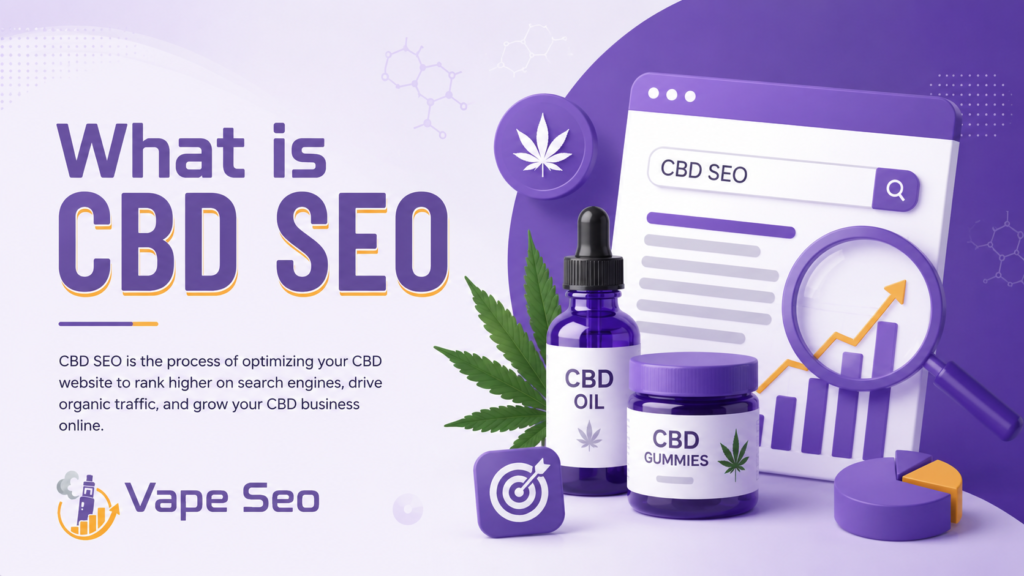
If you run a CBD brand, dispensary, or online store, you already know that getting customers to find you is half the battle. Traditional advertising channels like Google Ads and Facebook Ads have historically restricted or banned CBD and cannabis-related promotions, which makes organic visibility more important than ever. This is where CBD SEO comes in.
In this guide, we’ll break down what CBD SEO is, why it matters, and the specific strategies that help CBD businesses rank higher in search results without relying on paid ads that platforms may reject.
What Is CBD SEO?
CBD SEO (Search Engine Optimization for CBD businesses) is the practice of optimizing a CBD website, its content, and its technical structure so it ranks higher in organic search engine results pages (SERPs) for relevant keywords like “CBD oil,” “best CBD gummies,” “CBD for anxiety,” or “buy CBD near me.”
Unlike general SEO, CBD SEO deals with a unique set of challenges: strict advertising restrictions, evolving legal regulations, high competition, and search engines that treat CBD and hemp-related content with extra scrutiny because it falls under the “Your Money or Your Life” (YMYL) category. Google applies YMYL standards to any content that could impact a person’s health, financial stability, or safety and CBD products, since they relate to health and wellness, fall squarely into this bucket.
Because of these unique hurdles, a generic SEO strategy usually isn’t enough. CBD companies need a tailored approach that accounts for compliance, trustworthiness, and niche-specific keyword research.
Why CBD SEO Matters More Than Ever
1. Paid Advertising Restrictions
Google Ads, Facebook Ads, and Instagram Ads have long-standing policies that limit or prohibit the promotion of CBD and hemp-derived products, even in states or countries where they’re legal. This leaves organic search as one of the few reliable, scalable channels for customer acquisition. Investing in CBD SEO is often the most sustainable way to build long-term visibility.
2. High Competition in the CBD Market
The CBD industry has grown rapidly, and with that growth comes intense competition for top rankings. Ranking for keywords like “CBD oil for pain” or “full spectrum CBD” requires more than just publishing a few blog posts it requires a comprehensive, ongoing CBD SEO strategy.
3. Building Consumer Trust
Because CBD is still a relatively new and sometimes misunderstood category, consumers actively research before buying. A strong SEO presence complete with educational content, transparent lab results, and clear product information builds the credibility that converts visitors into repeat customers.
Key Components of a Successful CBD SEO Strategy
1. Keyword Research for CBD Niches
Effective CBD SEO starts with identifying the right keywords. This includes:
- Product-based keywords: CBD oil, CBD gummies, CBD tinctures, CBD topicals, CBD capsules, full-spectrum CBD, broad-spectrum CBD, CBD isolate
- Condition-based keywords: CBD for anxiety, CBD for sleep, CBD for pain relief, CBD for inflammation
- Local keywords: CBD store near me, buy CBD [city name], CBD dispensary [state]
- Informational keywords: what is CBD, CBD vs THC, is CBD legal, CBD dosage guide
Long-tail keywords (longer, more specific phrases) tend to convert better and face less competition, making them a smart focus for newer CBD websites trying to build authority.
Since CBD content falls under YMYL guidelines, Google places heavy emphasis on E-E-A-T signals. To strengthen these signals, CBD websites should:
- Publish content written or reviewed by professionals with relevant knowledge (naturopaths, herbalists, or medical advisors where appropriate)
- Include author bios with credentials
- Cite third-party lab testing (Certificates of Analysis) for every product
- Link to reputable, authoritative external sources when referencing health claims
- Avoid making unverified medical claims about curing or treating diseases, which can trigger both legal issues and search penalties
3. On-Page SEO Optimization
On-page elements remain foundational to any CBD SEO campaign:
- Title tags and meta descriptions that naturally include target keywords like “CBD oil,” “hemp extract,” or “CBD gummies for sleep”
- Header structure (H1, H2, H3) that organizes content logically and includes secondary keywords
- Image alt text describing product images with relevant keyword phrases
- Internal linking between product pages, category pages, and educational blog content
- Schema markup (structured data) for products, reviews, and FAQs to improve how listings appear in search results
4. Technical SEO for CBD Websites
Technical SEO ensures search engines can properly crawl, index, and rank your site:
- Site speed optimization : slow-loading pages hurt both rankings and conversions
- Mobile responsiveness : a majority of CBD shoppers browse on mobile devices
- Secure HTTPS protocol : essential for e-commerce trust and search rankings
- Clean URL structures : avoiding overly complex or keyword-stuffed URLs
- XML sitemaps and robots.txt : properly configured to help search engines crawl age-gated or restricted pages appropriately
5. Content Marketing and Blogging
A consistent content strategy is one of the most effective long-term CBD SEO tactics. Educational blog posts about topics like “CBD vs. THC: What’s the Difference,” “How to Choose the Right CBD Dosage,” or “CBD Oil Benefits: What the Research Says” help capture top-of-funnel traffic while establishing your brand as a trustworthy resource.
Content should be:
- Well-researched and fact-based
- Updated regularly to reflect the latest CBD regulations and studies
- Written in a way that avoids exaggerated health claims
- Optimized around both primary and secondary keywords
6. Local SEO for CBD Retailers
If you operate a physical CBD store or dispensary, local SEO is critical:
- Claim and optimize your Google Business Profile listing
- Ensure your name, address, and phone number (NAP) are consistent across directories
- Encourage and respond to customer reviews
- Create location-specific landing pages if you serve multiple cities or regions
7. Link Building for CBD Websites
Because CBD is a restricted category, many mainstream guest-posting and PR networks avoid the niche, making backlink acquisition more challenging. Effective strategies include:
- Partnering with cannabis and wellness-focused blogs and publications
- Getting listed in reputable CBD directories
- Earning organic backlinks through high-quality, shareable content (research summaries, original studies, infographics)
- Building relationships with industry influencers and podcasters in the wellness and hemp space
8. Compliance and Legal Considerations
CBD SEO cannot be separated from legal compliance. Search engines are more likely to penalize or de-index sites that:
- Make unsubstantiated medical claims (e.g., “cures cancer” or “eliminates anxiety”)
- Sell to or market toward minors
- Fail to include required disclaimers (such as FDA disclaimers in the U.S.)
- Operate in jurisdictions where CBD sales are restricted or banned
Working with legal counsel alongside your SEO and content teams helps ensure your marketing efforts don’t inadvertently create compliance risks.
Common CBD SEO Mistakes to Avoid
- Keyword stuffing: Overusing keywords like “CBD oil” unnaturally throughout content hurts readability and can trigger search engine penalties.
- Ignoring mobile optimization: A large share of CBD product searches happen on mobile devices.
- Neglecting page speed: Product-heavy e-commerce sites with unoptimized images load slowly, increasing bounce rates.
- Overpromising health benefits: Claims not backed by scientific consensus can lead to both legal trouble and reduced trust signals.
- Skipping local SEO: Even online-first CBD brands can benefit from location-based content if they ship to specific regions or states.
Measuring CBD SEO Success
To track the effectiveness of your CBD SEO strategy, monitor:
- Organic traffic growth (via Google Search Console and analytics platforms)
- Keyword rankings for target terms
- Conversion rate from organic visitors
- Domain authority and backlink growth
- Bounce rate and average session duration
- Local pack visibility (for brick-and-mortar CBD retailers)
Frequently Asked
1. What is CBD SEO and how is it different from regular SEO?
CBD SEO is the process of optimizing a CBD or hemp-related website to rank higher in organic search results. It differs from general SEO because it must account for advertising restrictions, YMYL (Your Money or Your Life) content standards, strict compliance requirements, and heightened scrutiny from search engines around health-related claims.
2. Why can’t CBD businesses just use Google Ads or Facebook Ads instead of SEO?
Most major ad platforms, including Google Ads and Meta Ads, restrict or outright ban the promotion of CBD and hemp-derived products, even in regions where they’re legally sold. This makes organic search rankings through CBD SEO one of the few scalable, long-term channels available for customer acquisition.
3. How long does it take to see results from CBD SEO?
Like most SEO efforts, CBD SEO is a long-term strategy. Depending on competition, domain authority, and content quality, businesses typically start seeing meaningful ranking improvements within three to six months, with more substantial growth over six to twelve months of consistent effort.
4. What are the best keywords to target for a CBD website?
Strong keyword categories include product-based terms (CBD oil, CBD gummies, full-spectrum CBD), condition-based terms (CBD for anxiety, CBD for sleep), local terms (CBD store near me), and informational terms (what is CBD, CBD vs THC). Long-tail keywords often convert better and face less competition.
5. Is it legal to make health claims in CBD SEO content?
Making unverified medical claims, such as saying CBD “cures” or “treats” a specific disease, can create serious legal risk and may also trigger search engine penalties. Effective CBD SEO content should stay factual, cite credible sources, include required disclaimers, and avoid overstating health benefits.
Final Thoughts
CBD SEO is not just another marketing buzzword it’s often the primary growth channel available to CBD businesses given the restrictions on paid advertising. A successful strategy combines strong keyword research, high-quality and compliant content, technical optimization, local SEO tactics, and a genuine commitment to trustworthiness and transparency.
By investing in CBD SEO now, hemp and CBD brands can build sustainable, long-term organic visibility that continues generating traffic and sales regardless of how advertising platform policies shift in the future.
Whether you’re launching a new CBD brand or trying to improve the rankings of an established store, focusing on these core CBD SEO principles will help you build a durable competitive advantage in a crowded, fast-growing market.